Rock Slope Stabilization
Rock Slope Stabilization
At Hark Drilling, we specialize in comprehensive solutions for rock slope stabilization, ensuring the safety and durability of terrain in critical areas.
Rock Slope Stabilization Services
Unstable rock above a highway, building pad, or excavation is a risk that grows with every freeze and thaw cycle and every monsoon storm. Hark Drilling provides engineered slope stabilization for developers, general contractors, geotechnical engineers, and public agencies across the Intermountain West. Our crews combine rock drilling, anchoring, mesh, and shotcrete under one contractor. For more than 20 years, we have worked the road cuts, hillsides, and canyon walls of Utah, Arizona, and the surrounding states, and we build every system to fit the ground conditions and the engineer's design.
What Rock Slope Stabilization Involves
Rock slope stabilization lowers the risk of rock failure on natural slopes and on man-made cuts. Depending on the geology and what sits below the slope, the work controls the hazard in one of two ways.
Stabilization works at the source: it removes loose material and reinforces the rock mass so blocks and wedges stay in place. Rockfall mitigation manages what the slope may still release: it catches, guides, or absorbs falling rock before it reaches a roadway, a structure, or a work zone. Most projects need both. The right balance depends on the rock type, the fracture pattern, the slope height, the available access, and what failure would cost.
Our Slope Stabilization Services
Hark Drilling self-performs the core methods used on rock slopes. That lets us sequence the work efficiently and keep one crew accountable from start to finish.
Scaling: Rope access crews carry out manual scaling, and equipment handles mechanical scaling. Both remove loose rock and overhangs before any reinforcement goes in.
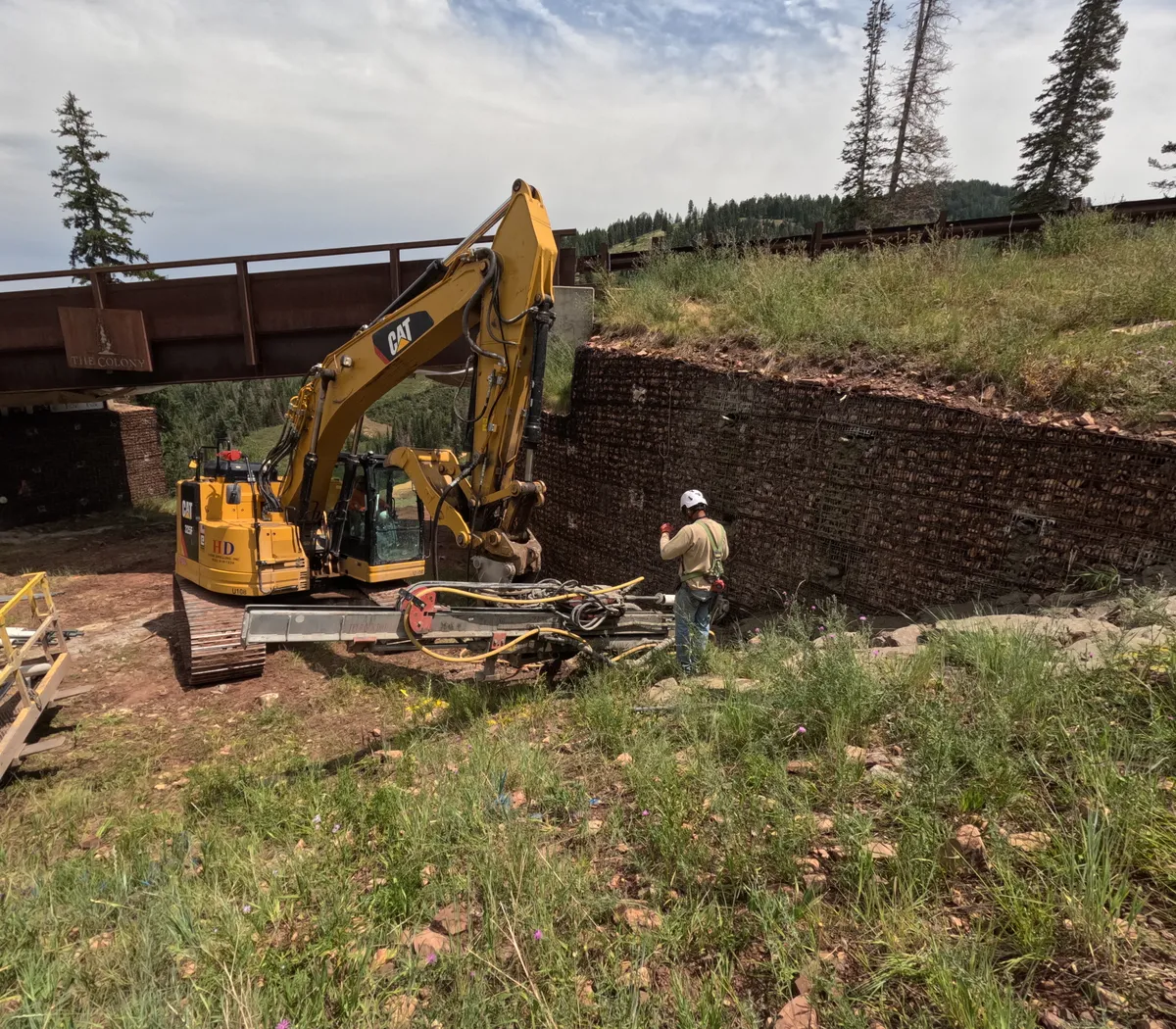
Rock Anchors and Rock Bolts: Grouted steel anchors are drilled into competent rock to tie loose blocks back to the stable rock mass. We also use them for spot bolting and for anchoring mesh.
Rock Pinning: Targeted anchors secure isolated blocks and fractured zones where full coverage isn't needed.
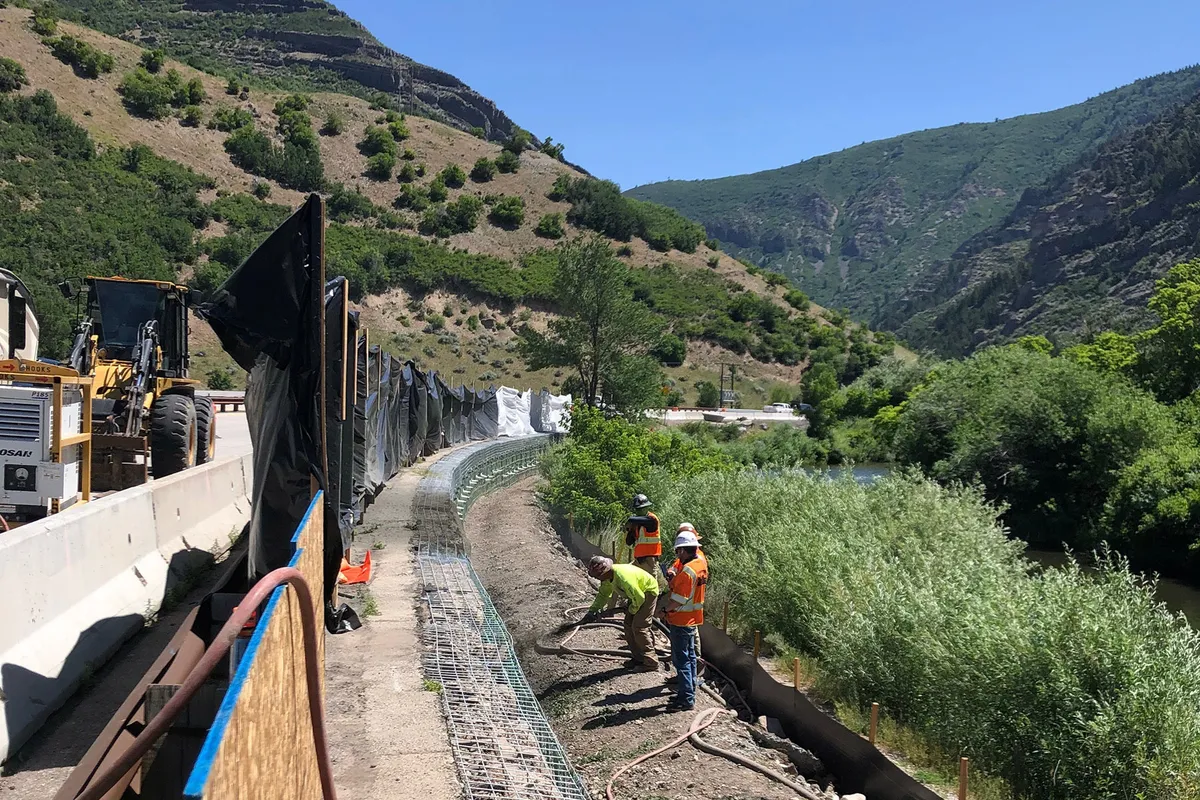
Draped and Pinned Mesh: Wire mesh and cable net systems either guide falling rock down to a catchment area at the toe of the slope or, when fully pinned, hold the rock face in place
Shotcrete: A reinforced concrete facing seals and supports weathered or fractured rock.
Soil Nails: Passive reinforcement for slopes that transition from rock into overlying soil.
Rockfall Barrier Fence and Impact Attenuators: Flexible systems absorb and dissipate the energy of falling rock to protect the areas below.


Our Rock Slope Stabilization Process
Every project is built to engineer-designed plans. We can work from plans provided by your geotechnical engineer, or we can deliver a design-build package through our network of engineering partners. A typical project follows this sequence:
• Plan and Report Review: We study the geotechnical report, the rock mass data, and the design drawings to confirm anchor lengths, drilling methods, and material specifications before mobilizing.
• Access and Safety Planning: Steep and confined slopes need careful staging. We plan equipment placement, rope access, traffic control coordination, and fall protection around the site.
• Scaling: Loose rock is removed from the top of the slope down so crews can work safely below.
• Drilling and Anchor Installation: We match rock drills to the required hole depth, diameter, and rock hardness. Anchors are installed, grouted, and tested to the project specification.
• Facing and Protection: Mesh, shotcrete, and barrier systems are installed as the design calls for.
• Verification and Closeout: Test results, as-built records, and a final walkthrough with the engineer of record close out the project.

Shotcrete for Slope Stabilization
Shotcrete is concrete applied pneumatically at high velocity, by the wet mix or dry mix process, onto a prepared surface. It is one of the most versatile tools in slope stabilization because it takes the shape of irregular rock faces without formwork and can be placed on steep and overhead surfaces.
On rock slopes, shotcrete is used to:
• Seal fractured and weathered rock against further weathering and raveling
• Provide a structural facing over rock bolts and soil nails
• Line cut faces during excavation to hold the ground while work continues
• Protect the rock around anchor heads and transitions between rock and soil
Depending on the design, shotcrete is reinforced with welded wire mesh, reinforcing bars, or fibers, and drainage is built in to relieve water pressure behind the facing. Quality depends on the person at the nozzle, which is why Hark's shotcrete is placed by ACI Certified Nozzlemen. Our shotcrete work also covers shoring walls, soil nail walls, and basement excavations, so the same crews can support a project from the rock slope down to the foundation.
Slope Stabilization Across the Intermountain West
Geology drives design, and conditions vary widely across the region we serve.
Utah: Highway cuts along I-15 and I-80, canyon roads, and hillside developments along the Wasatch Front expose limestone, sandstone, quartzite, and heavily fractured rock. Freeze-thaw cycles steadily open joints and loosen blocks, and the seismic activity along the Wasatch Fault adds to the design load on anchored systems. Our Salt Lake City office puts crews close to projects throughout the state.
Arizona: Around Phoenix, granite and volcanic rock in desert cuts and hillside lots bring their own drilling challenges. In Northern Arizona, basalt, cinder deposits, and sandstone formations call for different approaches, and intense monsoon storms can loosen material on slopes that have stood for years. Our Phoenix office supports projects across the state.
Colorado, Idaho, Montana, New Mexico, and Wyoming: Mountain transportation corridors, mining sites, and remote infrastructure often combine difficult access with challenging rock. Our crews and equipment are set up to mobilize to these sites.
Rockfall Mitigation Applications
Our rockfall mitigation and slope stabilization services support a wide range of project types:
• Transportation: DOT highway cuts, canyon roads, and rail corridors where falling rock threatens traffic
• Commercial and Residential Development: Hillside building pads, subdivisions, and homes below natural rock outcrops
• Excavation: Building pads and basement excavations cut into rock, where the exposed face must stay stable during construction
• Mining and Industrial Sites: Haul roads, benches, and facility areas below active or weathered slopes
• Public Infrastructure: Utility corridors, water facilities, and public lands where people and assets sit below a slope
Typical project scopes include rehabilitating a fractured highway cut with scaling, spot bolting, and draped mesh while traffic keeps moving; stabilizing a hillside building pad with rock anchors and a shotcrete facing before vertical construction starts; and installing rockfall barrier fence above homes or roads where source control alone isn't practical.
Why Engineers and Contractors Choose Hark Drilling
• Over 20 years of experience in soil stabilization and deep foundations across the Intermountain West
• ACI Certified Nozzlemen and experienced drilling and rope access crews
• Our own rock drills and anchoring equipment, backed by supplier and partner relationships that keep materials and resources moving
• Design-build capability, or construction to your engineer's plans
• One contractor for related scopes, including rock anchors, soil nails, micropiles, tiebacks, shoring, and ground modification
• Offices in Phoenix and Salt Lake City, serving Arizona, Colorado, Idaho, Montana, New Mexico, Utah, and Wyoming
Rock Slope Stabilization | Frequently Asked Questions
How are rocks removed?
Loose rock is removed by scaling. Rope access crews use scaling bars and hydraulic or pneumatic tools where needed to bring down loose blocks by hand. Mechanical scaling uses equipment on slopes it can safely reach. Larger blocks may be removed in a controlled way or anchored in place, depending on the design. Debris is cleared from the toe of the slope once scaling is finished.

How are rock slope nets installed?
Anchors are drilled and grouted along the crest of the slope, and support ropes are attached to them. Mesh or cable net panels are then lowered down the face, joined together, and secured. Draped systems hang freely to guide falling rock to the toe. Pinned systems add a grid of anchors across the face and are tensioned to hold the rock in place.

How long do rock slope nets last?
Most systems use galvanized or zinc- and aluminum-coated steel and are designed for decades of service. Actual service life depends on the corrosion environment, how much rock the system collects, and maintenance. Regular inspections and clearing debris at the toe help keep a system performing as designed.
What is the capacity of rock slope nets?
Capacity depends on the system. Draped mesh is designed to guide rock, not stop it, and its capacity comes from the mesh strength and the anchors at the crest. Pinned systems are designed around the loads of the rock they restrain. Rockfall barrier fences are rated by the impact energy they can absorb, measured in kilojoules. The engineer of record sets the required capacity based on the expected block size, fall height, and slope geometry.

Discuss Your Slope Stabilization Project
If your project sits below an unstable rock slope or cuts into one, the right stabilization system should be planned before the first drill hole. Contact Hark Drilling to review your geotechnical data, site access, and project scope. We'll help you put an engineered solution in place that protects the site, the schedule, and the people working below.

ARIZONA
12225 W. PEORIA AVE. SUITE A | EL MIRAGE, AZ 85335
UTAH
210 WEST 5TH AVE. | MURRAY, UT 84107
COPYRIGHT © 2024 HARK DRILLING, INC. | WEBSITE DESIGN BY ALL IN ADVERTISING