Shoring Services
Every deep excavation changes the ground around it. Cut a basement, a parking level, or a utility corridor, and the soil that supported the adjacent street, utilities, and buildings has to be held in place by something else. Excavation shoring is that something else, and it should be settled at the design stage, before the first lift comes out of the hole.
Hark Drilling has delivered shoring, soil stabilization, and deep foundation work across the Intermountain West for over 20 years. From our offices in El Mirage, Arizona, and Salt Lake City, we install engineered shoring systems for general contractors, geotechnical engineers, developers, and public agencies.
What Is Shoring in Construction?
Shoring is a temporary or permanent support system that holds soil, rock, or an existing structure in place while work happens beside or below it. In excavation work, shoring keeps the sides of a cut stable and close to vertical, so crews can build safely, neighboring property stays where it is, and the excavation doesn't have to be sloped back across land you don't own.
Shoring construction is usually required when one or more of these conditions apply:
The excavation reaches 5 feet or deeper; OSHA requires a protective system at that depth unless the cut is entirely in stable rock
Property lines, streets, or neighboring foundations leave no room to slope or bench the cut
Utilities, roadways, or existing structures sit close enough to be affected by ground movement
Groundwater, loose fill, or granular soils make an open cut unstable
The shoring plan also shapes the schedule. Tiebacks are usually needed once an excavation goes deeper than about 15 feet or carries significant surcharge loads, and anchors that extend past the property line may require easements before drilling starts.
Types of Shoring and Where Each One Applies
No single system fits every site. The types of shoring below cover most commercial, residential, and infrastructure excavations, and many projects combine two or more under one crew. A deep basement excavation, for example, may pair soldier piles with tiebacks and a shotcrete facing.
Soldier Pile and Lagging
Steel H piles or reinforced concrete shafts are drilled from grade at regular intervals, and lagging is placed between them in lifts as the excavation advances. Lagging is typically timber or shotcrete; timber lagging is where timber shoring still plays a central role on large excavations, while shotcrete provides a harder, continuous face. Soldier pile walls adapt well to tight property lines and congested utilities, which makes them a staple on infill lots in Phoenix and Scottsdale. Learn more about soldier piles and lagging.
Sheet Pile Walls
Interlocking steel sheets are driven continuously, using a crane with a vibratory or impact hammer, to form a nearly watertight wall without excavating first. Sheet piles are a strong choice when groundwater or water exclusion rules out an open lagged wall, and when the design allows, they can be extracted and reused. See our sheet pile services.
Soil Nail Walls and Shotcrete
Soil nailing reinforces the ground in place. Working from the top down in lifts, crews drill and grout high-strength steel bars into the cut face, then cover the face with mesh or rebar and shotcrete. Nail lengths are set by the engineer and range from 10 to 100 feet, and we install both solid bar and hollow bar systems to suit the ground. Soil nail walls are a cost-effective option for cuts in cohesive desert soils and on hillside sites around Prescott and Flagstaff, and our shotcrete is placed by ACI Certified Nozzlemen. Read more about soil nail walls.

Tiebacks and Rock Anchors
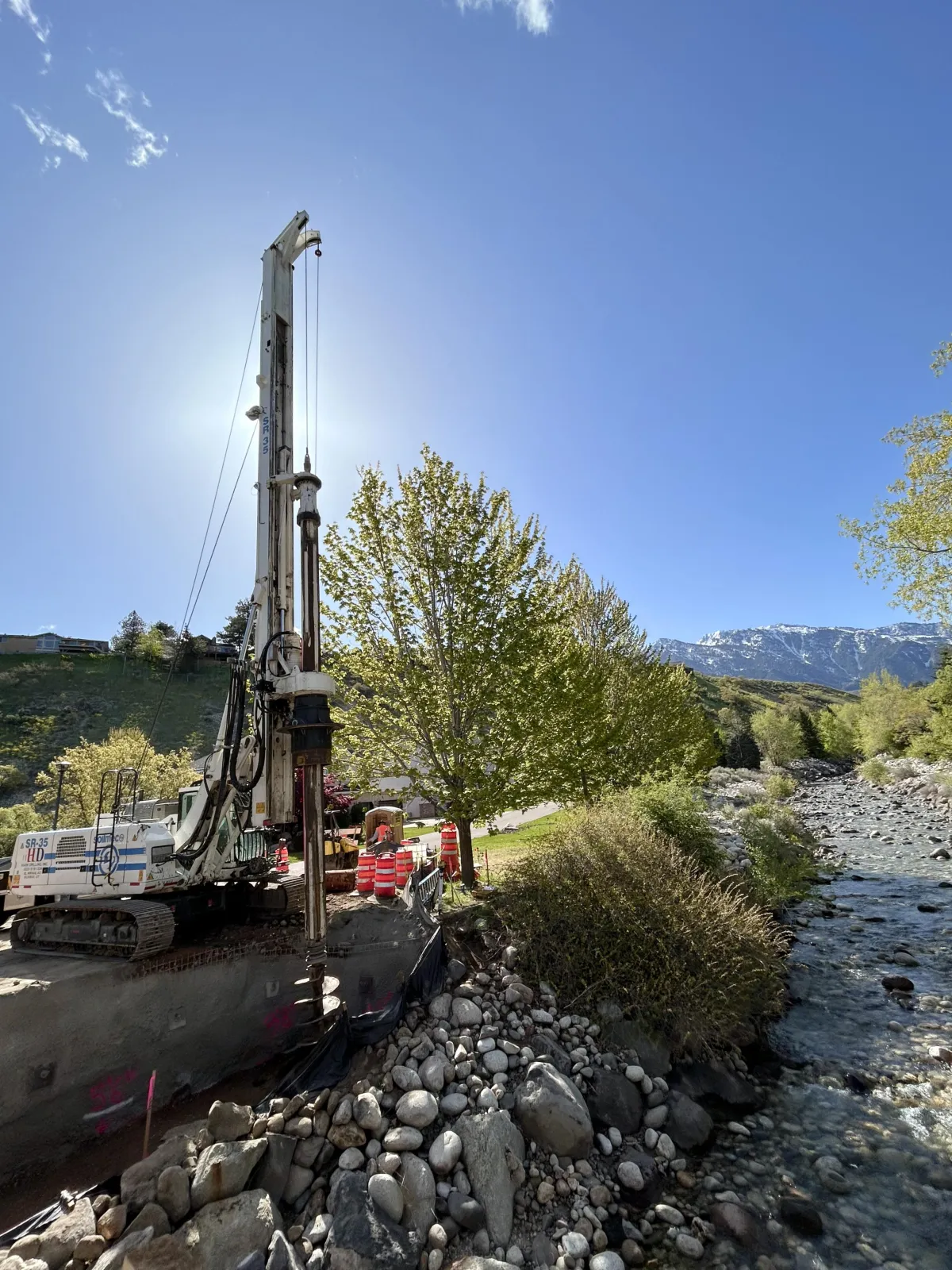
Tiebacks provide lateral support for soldier pile and shotcrete walls. Each anchor is drilled at an angle into the soil or rock behind the wall, grouted through a bond zone, and then stressed and locked off to limit deflection as the excavation deepens. Hark installs steel bar and strand tiebacks up to 100 feet deep. Where the cut is in rock, the same principle applies through rock anchors and rock pinning, often alongside rock slope stabilization. More detail is on our tiebacks page.
Micropiles and Underpinning
When an excavation runs beside an existing foundation, the neighboring structure may need support before the cut goes down. Micropiles are small-diameter, drilled and grouted elements that our compact rigs can install in restricted access areas, including inside buildings. Unlike helical piers, they can be load-tested after installation, which makes them a reliable underpinning tool. Explore our micropile foundations.
Trench Shoring: Hydraulic, Slide Rail, and Timber Systems
Trench shoring protects crews and adjacent infrastructure during utility, pipeline, and site development work. The common systems each have a defined range:
Hydraulic shoring: aluminum rails and hydraulic cylinders are installed from the surface and pressurized against the trench walls; it suits shorter, shallower runs in cohesive soils
Slide rail shoring: steel panels slide into vertical rails that are pushed down as the trench is dug, forming a continuous wall for deeper, longer utility trenches and pits
Timber shoring: uprights, wales, and cross braces sized from OSHA's tables; still useful for irregular trench shapes and short runs
OSHA's standard timber and aluminum hydraulic shoring tables stop at 20 feet. Deeper trenches, or cuts beside sensitive structures, need an engineered system: often soldier piles, sheet piles, or a hybrid wall. Hark's trench shoring services match the method to the depth and soil classification of each cut.
Temporary and Permanent Shoring
Most excavation shoring is temporary shoring: it holds the ground until the permanent structure can carry the load. Many of the same systems, including soldier pile walls, soil nail walls, sheet piles, and tieback walls, can also be designed as permanent retaining walls. Make that call early; it affects corrosion protection, facing, and cost.
Shoring Services Across Arizona
Arizona ground is rarely uniform. Across the Phoenix metro, caliche hardpan can drill more like rock than soil, and expansive clays push harder on a wall than generic assumptions allow. Granite and volcanic rock show up in hillside lots and desert cuts. In Northern Arizona, basalt, cinder deposits, and sandstone call for different drilling methods, and monsoon storms can loosen slopes that have stood for years. Pima County brings its own mix of caliche and expansive clays.
Our Arizona office serves project sites throughout Maricopa County and the rest of the state; learn more about our work as a Phoenix foundation contractor. Together with our Salt Lake City office, we serve Arizona, Colorado, Idaho, Montana, New Mexico, Utah, and Wyoming.
Find a Shoring Contractor in Your Arizona City
Select your project location for shoring services in that market.
Phoenix metro:
Shoring services in Phoenix, AZ
Shoring services in Scottsdale, AZ
Shoring contractor in Tempe, AZ
Commercial shoring services in Chandler, AZ
Shoring contractor in Gilbert, AZ
Shoring contractor in Peoria, AZ
Commercial shoring services in Surprise, AZ
Northern Arizona:
Shoring services in Flagstaff, AZ
Shoring services in Prescott, AZ
Shoring in Prescott Valley, AZ
Southern Arizona:
We also take projects in Avondale, Buckeye, Queen Creek, Casas Adobes, Catalina Foothills, and communities across the state.
Why Developers and Engineers Choose Hark Over Other Shoring Companies
Hark works as a shoring contractor, not an equipment supplier: we plan the system with your engineer or ours, install it with our own crews and equipment, and stay accountable for it through the excavation.
Over 20 years of soil stabilization and deep foundation experience across the Intermountain West
Engineering flexibility: we can provide engineered plans through our engineering partners or build to your engineer's design
Shotcrete placed by ACI Certified Nozzlemen
A drilling fleet that ranges from large rigs for open commercial sites to low clearance equipment for constrained urban lots
One contractor for shoring, tiebacks, drilled piers, micropiles, and ground modification, so excavation support and foundations are sequenced together
Offices in the Phoenix metro and Salt Lake City, with crews ready to mobilize across seven states
Plan Your Excavation Shoring Before the First Cut
The best time to solve a shoring problem is before mobilization. Send us your geotechnical report, excavation depth, site plan, and schedule, and we'll recommend a system that fits the ground, the neighbors, and the budget. Contact Hark Drilling to discuss your Arizona project, or call our Arizona office at 623.434.3105.

ARIZONA
12225 W. PEORIA AVE. SUITE A | EL MIRAGE, AZ 85335
UTAH
210 WEST 5TH AVE. | MURRAY, UT 84107
COPYRIGHT © 2024 HARK DRILLING, INC. | WEBSITE DESIGN BY ALL IN ADVERTISING